 Pay Audit
For NHS doctors · England and Wales
Your pay, checked across every year and every post.
One payslip tells you about one month, from one job, as one payroll understood it. Pay Audit reads all of them, combines your posts, and checks the picture no single payroll can see — thirty-six checks in all.
No account. Nothing uploaded — it reads on your own device.
Every line reconciled, with the amount and the reason for any gap.
What you can put in
Whatever form your payslip is in
You should not have to log into ESR to check your own pay. Photograph it, screenshot it, or use the PDF — it reads all three.
Payslips
A photograph taken on your phone, a screenshot from a computer, the PDF from ESR, or a whole folder of them at once. Bank and locum posts too — add every post you have.
P60s
Your end-of-year certificate, so it can check that the payslips you hold add up to what your employer actually reported.
Your contract
Your contract of employment or job plan, so it can check you are being paid the hours, sessions and pay point it states.
Nothing is uploaded. Files are read inside the page and stay on your device.
What it does
Rebuilds your pay from the rules, then compares
Not a rough estimate. It recalculates each line from the source that should have produced it, and puts the two side by side.
Your pay
Basic against the pay circular for your grade and pay point. Additional rostered hours, night enhancement, weekend frequency, on-call availability, banding, London weighting, and programmed activities for SAS and consultant grades. Full time or less than full time.
Your deductions
Income tax recalculated from scratch on a cumulative basis from your tax code. National Insurance. The NHS pension tier your pensionable pay puts you in. Student and postgraduate loan plans.
Your whole year
Every post you have added, combined — because two payrolls cannot see each other, and that is where most problems live. Then checked against the P60 your employer filed.
Your position on the scale
Where your NHS service should have put you, which pay point comes next, and when it falls due. Useful when progression has quietly stopped.
Across the year
The findings that need more than one payslip
These are the ones worth real money, and none of them can be seen from a single month. They are why the app asks for every payslip and every post you have.
Every post, combined
Two employments each get a tax code, and neither payroll can see the other. Above a certain total income that matters a great deal — and only a combined view shows it.
Against your P60
Whether the payslips you hold add up to what your employer actually reported to HMRC. Where they do not, a payslip is usually missing.
A year that never settled
A month 1 code cannot correct itself. The app can tell you the year finished out of balance and by how much, which no individual payslip will say.
Every tax code you have been on
A timeline across the year, so a code that changed four times — and the correction that landed in your pay each time — is visible at once.
What you get out
A figure, a reason, and something you can send
The verdict
Whether your pay adds up, and if not, by how much and in which year. Stated in pounds, at the top, before any of the working.
The working
Every line of the payslip beside what it should have been, so you can see exactly where a gap comes from rather than taking it on trust.
The letter
A wrong pay figure is payroll's; a wrong tax code is HMRC's. It drafts to whichever applies, quoting the figure and the rule behind it.
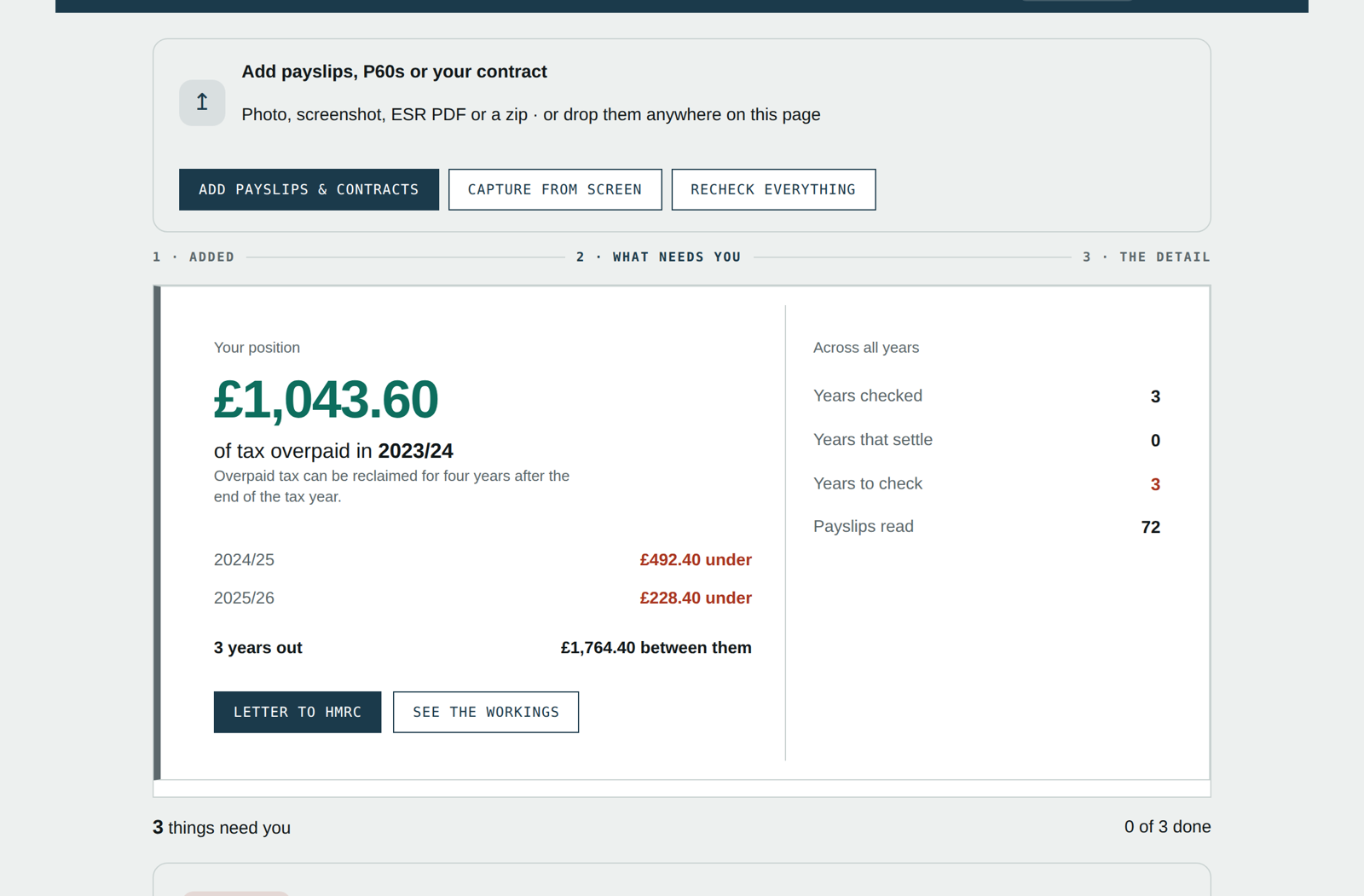
And a report you can print
Your position year by year, anything worth acting on, and any payslips missing from the picture — as a document you can save, print or send on.
What it will not do
It tells you when it cannot tell you
It will not guess
Where a rate is not loaded, it says so instead of estimating. A flagged gap is worth more than a confident wrong number in a letter to payroll.
It checks itself first
Every payslip must reconcile against its own printed totals before anything is reported from it. One that does not is flagged for you to look at.
It is not advice
It shows the arithmetic and the rule it relied on so you can judge for yourself. It is independent of the NHS, ESR and HMRC.
Not sure whether it applies to you?
Three questions
Answer three things you already know and it will tell you which of the common causes are worth looking for on your own payslip. Nothing is stored or sent.
Nothing you answer here is stored or sent anywhere.
Pricing
Free to check
Checking a payslip costs nothing and always will. A licence is for keeping your payslips between visits and for the checks that need more than one of them.
It takes a minute and costs nothing
One payslip is enough to find out whether there is anything to find.